It’s one of the first questions couples ask me: “If we have a celebrant, are we actually married?” It’s a fair question, and the answer is easy to work around once you know how.
The short answer
In England and Wales, independent celebrants can’t currently conduct the legal part of a marriage. A legal marriage has to be conducted by a registrar or an authorised religious minister, with prescribed legal wording and two witnesses. A celebrant-led ceremony is the personal, meaningful ceremony — but the legal registration is done separately.
Plenty of couples actually prefer it this way. It means the legal side is quick, quiet and inexpensive, and the ceremony you share with family and friends can be held anywhere, at any time, with no restrictions on the words, music or readings.
Note: in 2026 the Government consulted on reforming wedding law, including whether independent celebrants should be able to conduct legal weddings. Until the law actually changes, the process below is how it works. (The rules are different in Scotland and Northern Ireland.)
Step 1: Give notice of marriage
Both of you need to give notice of your intention to marry at your local register office. In England and Wales:
- You must have lived in that registration district for at least the past seven days.
- You must give notice at least 29 days before your legal ceremony.
- Your notice is valid for 12 months, so your legal ceremony needs to happen within that time.
- You’ll need to bring documents such as proof of identity, nationality and address, and pay a fee.
If you live in different districts, you can each give notice at your own register office. Rules are different if either of you is from outside the UK or Ireland, so check the official gov.uk guidance or ask your register office before booking anything.
If you live in Leicester, notice is given through Leicester City Council; elsewhere in the county it’s Leicestershire County Council’s registration service.
Step 2: Book a simple legal ceremony
Most register offices offer a short, simple ceremony — sometimes called a statutory, basic or “two plus two” ceremony (the two of you plus two witnesses). It usually takes place in a small room at the register office, lasts a few minutes, and is the most affordable option. Weekday slots are typically cheaper than weekends. Names and pricing vary between councils, so check your local register office’s website.
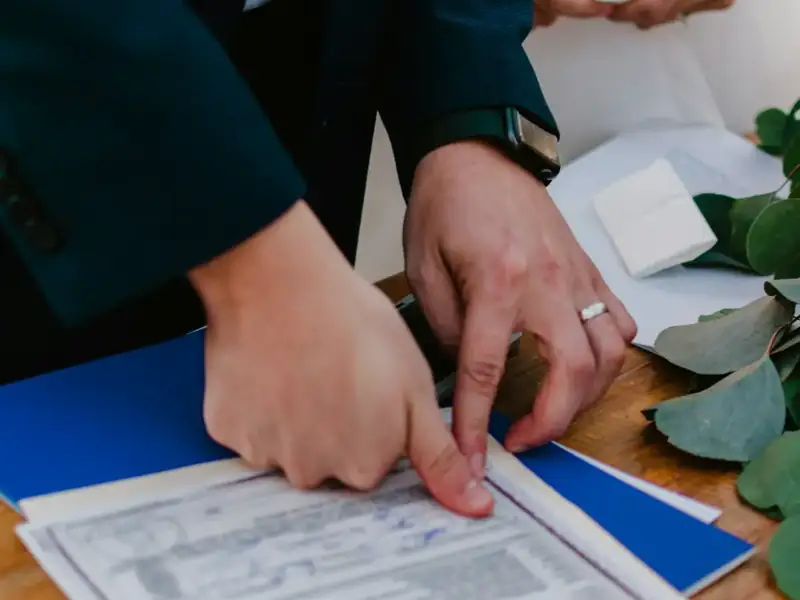
At this ceremony you’ll say the prescribed legal words, sign the marriage schedule, and that’s it — you’re legally married.
Want a ceremony that sounds unmistakably like you two?Start with a free, no-pressure 30 minute video call.
Book a free consultationStep 3: Decide on your timing
You can do the legal bit before, on, or after your celebrant ceremony. Each has its fans:
- A few days or weeks before: the most popular choice. Your legal paperwork is done, and your wedding day is the one everyone celebrates as your anniversary.
- On the same day: possible if the register office is near your venue, but it can make the day feel rushed.
- Afterwards: works if you need more time to give notice, or you’re planning a destination-style celebration first.
Some couples keep the legal ceremony private — just the two of you and your witnesses, perhaps followed by lunch — so the celebrant ceremony feels like “the” wedding. Others invite close family to both.
Step 4: Your celebrant ceremony
Now for the part everyone will remember. Because it isn’t the legal ceremony, a celebrant-led wedding can:
- take place anywhere you have permission to be — a garden, barn, woodland, beach or unlicensed venue
- happen at any time of day, including evening or sunset
- include religious, spiritual or cultural elements if you want them
- include your own vows, readings, music, rituals and as many people as you like
- last as long as it needs to, without being squeezed into a time slot
Many couples include a ceremonial signing — a beautiful certificate signed by the couple and witnesses — so there’s still that moment for photos.
Do guests need to know?
That’s entirely up to you. Many couples don’t mention it at all. Others like to acknowledge it with a light touch — something like “Sam and Alex made it official at the register office last week, but today is the day they make their promises in front of all of you.”
What about vow renewals, naming ceremonies and funerals?
None of these have the same legal requirement, so a celebrant can lead them from start to finish, anywhere you like.