One of the joys of a celebrant-led wedding is that there’s no fixed script. But most couples still find it reassuring to see a typical running order. Here’s a structure that works beautifully for most ceremonies, with rough timings. A full ceremony usually lasts 20 to 40 minutes.
Before the ceremony
- Guests arrive and are seated (15–30 minutes before). Background music playing.
- Your celebrant checks in with the venue, musicians, photographer and whoever is walking in with you, and runs through any final details.
- A quick welcome for guests: the celebrant may say a few words a few minutes before the start — asking people to silence phones, or to keep the aisle clear for the photographer (an “unplugged ceremony”).
1. The processional (2–4 minutes)
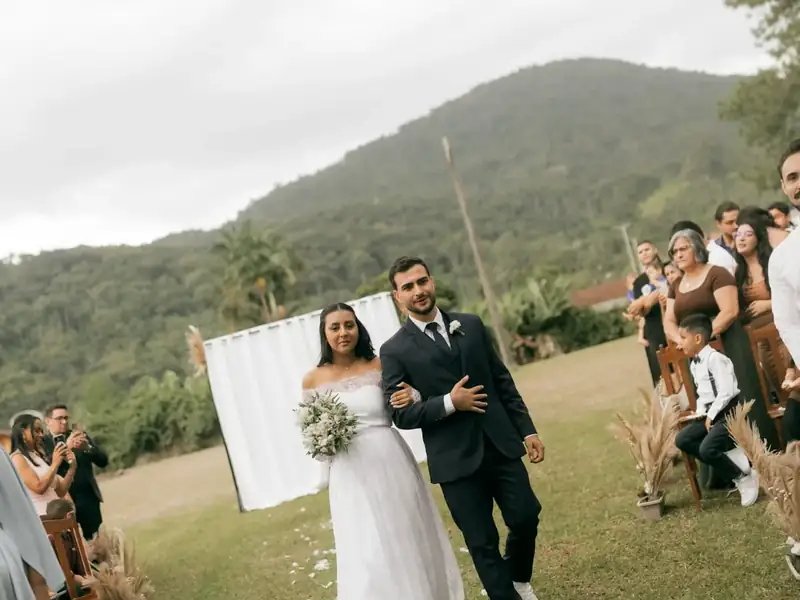
Your entrance. Whoever is walking in — one of you, both of you together, with a parent, with children, or with the whole wedding party — walks down the aisle to your chosen music. There are no rules: some couples walk in together, some both walk in separately.
2. Welcome and introduction (2–3 minutes)
Your celebrant welcomes everyone, introduces the day and sets the tone. This is also the place to acknowledge anyone who can’t be there, if you’d like to remember loved ones who have died.
Want a ceremony that sounds unmistakably like you two?Start with a free, no-pressure 30 minute video call.
Book a free consultation3. Your story (5–8 minutes)
This is the heart of a celebrant ceremony, and what makes it so different from a standard service. Your celebrant tells the story of your relationship: how you met, the moment you knew, the adventures and the ups and downs, the things your friends tease you about. It’s written from your conversations and questionnaire, and it’s usually where the laughter (and the first tears) happen.
4. A reading (2–4 minutes)
A friend or family member reads a poem, a passage from a book, song lyrics you love, or something they’ve written themselves. You can have one reading, two, or none at all. Many couples place one here and one after the vows.
5. The intentions or “asking” (1–2 minutes)
Your celebrant asks each of you whether you come here freely and wish to commit to each other — your chance to say “I do” or “I will”. It’s short, but it’s a lovely, simple moment.
6. Your vows (2–5 minutes)
You make your promises to each other — either vows you’ve written yourselves, vows repeated after your celebrant, or a mix. See our guide on how to write your own vows.
7. Exchange of rings (2–3 minutes)
You exchange rings with a few words. Rings could be brought up by a best friend, a child, or passed around the guests beforehand in a ring warming so everyone has blessed them.
8. A ritual (3–5 minutes, optional)
A handfasting, unity candle, sand ceremony, wine box, tree planting — or something completely unique to you. See our list of wedding ceremony ritual ideas.
9. The declaration and first kiss (1 minute)
Your celebrant declares you married (or “husband and wife”, “wife and wife”, “husband and husband” or simply “partners for life” — whatever you prefer). The kiss, the cheer, the confetti moment many couples save for later.
10. Ceremonial signing (3–5 minutes, optional)
Many couples sign a keepsake certificate with their witnesses. It isn’t a legal document (the legal registration is done separately in England), but it gives you that classic signing moment for photos, often with a song playing.
11. Closing words and recessional (2–3 minutes)
Your celebrant closes the ceremony and gives guests any directions — drinks on the lawn, photos by the tree. Then you walk back down the aisle together, married, to your chosen song. Confetti optional but highly recommended.
Where to put music
Most ceremonies use three to four pieces of music: guests arriving, the processional, the signing, and the recessional. You might also add a song in the middle, played live or recorded, as an alternative to a reading.
Making the order your own
This running order is a starting point. You might swap things around, add a moment for your children, include a cultural tradition, remember someone special, or get your whole guest list involved. That’s the point of a celebrant ceremony: we build it around you.